
Engineering Question
How Do Commercial Generators Work?
Commercial generators start on a utility outage, produce electricity, and feed selected building loads through automatic transfer switches.

Reviewed by
Michael K. Frempong, PE, LEED AP
President & Principal Engineer, BEED Engineering
Michael K. Frempong is a professional engineer and LEED AP accredited professional with over 20 years of experience in consulting engineering. As President & Principal Engineer at BEED Engineering, he leads the firm’s MEP design and consulting work for laboratory, healthcare, industrial, data center, education, commercial, municipal, and other building projects throughout Florida.
View BEED team profileQuick Answer
A commercial generator is an on-site engine-driven power source that starts when utility power fails. An automatic transfer switch disconnects the normal source and connects selected loads to the generator. The system is designed around which loads must remain on—life safety, critical operations, or broader standby needs—and how long the generator must run.
On this page
What happens during an outage
- Utility power is lost.
- The automatic transfer switch (ATS) senses the outage.
- The generator starts and reaches acceptable voltage and frequency.
- The ATS transfers selected loads to the generator.
- When utility power is stable again, the ATS transfers back and the generator cools down.
That is the practical core of emergency power.
What the engineer designs
- Load list and load calculation
- Generator sizing, including starting of motors
- ATS arrangement
- Fuel system and runtime
- Exhaust, ventilation, and sound
- Distribution of emergency versus optional standby loads
- Interface with fire alarm and building automation
Emergency versus standby
Life-safety loads (egress lighting, fire alarm, some elevators) follow stricter rules than optional standby loads (convenience cooling, selected receptacles). Mixing them casually creates code and operational problems.
Florida considerations
Coastal wind, flood elevation, fuel availability after storms, and owner expectations after hurricanes all influence placement and capacity. See electrical engineering in Brevard County and Treasure Coast MEP.
When to involve an engineer
Involve an engineer before purchasing a generator. The machine has to match the load, the ATS, the code path, and the physical site.
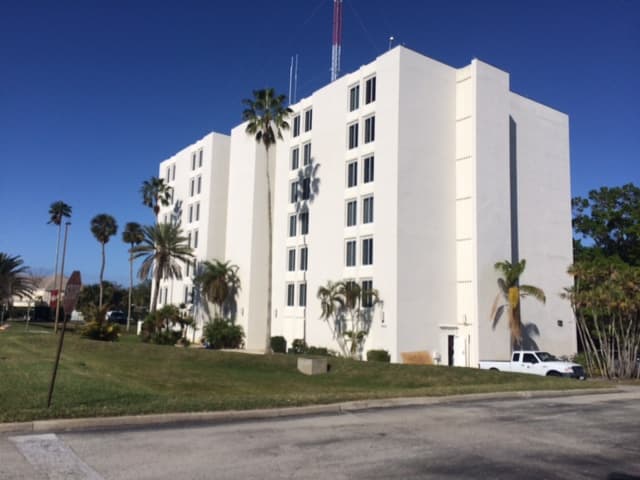
Automatic transfer switches sit on the same emergency-power problem. BEED designed UPS and ATS provisions for the WFIT transmitter room expansion at Florida Tech.
Related BEED projects
All projects →Selected work that shows how BEED has applied this kind of engineering on real buildings.
Data Centers
Florida Institute of Technology
WFIT Transmitter Room Expansion
Melbourne, Florida
350 SF
Mechanical + Electrical + Plumbing
MEP engineering for a 350-square-foot WFIT transmitter room expansion on the seventh floor of Roberts Hall at Florida Institute of Technology in Melbourne, Florida.
View Project →
Food Service
Domino's
Port Orange
Port Orange, Florida
1,400 SF
Mechanical + Electrical + Plumbing
MEP engineering for a 1,400-square-foot Domino's restaurant in Port Orange, Florida, with customer, production, storage, and walk-in cooler spaces.
View Project →
Food Service
Firehouse Subs
West Melbourne
West Melbourne, Florida
1,700 SF
Mechanical + Electrical + Plumbing
MEP engineering for a 1,700-square-foot Firehouse Subs restaurant in West Melbourne, Florida, with seating, food preparation, and office space.
View Project →Common Questions
Will a generator power the entire building?
Only if it is sized and connected that way. Many systems serve a defined emergency or standby load, not every receptacle.
Do generators need fuel storage and exhaust design?
Yes. Fuel type, tank location, exhaust, combustion air, and sound all require coordinated mechanical and electrical design.
Filed under Electrical Engineering
Continue exploring
Related Questions
What Is Emergency Power?
Emergency power is the legally required backup source that keeps life-safety and other designated loads operating when normal utility power is lost.
What Is Electrical Power Distribution?
Electrical power distribution is the path from the utility service through switchgear and panels to the building’s lights, receptacles, and equipment.
What Is a Fire Alarm System?
A fire alarm system detects fire signatures, notifies occupants, and interfaces with other life-safety systems according to the building’s occupancy and code path.
What Is Commercial Electrical Engineering?
Commercial electrical engineering is the design of power, lighting, emergency systems, and fire alarm infrastructure for non-residential buildings.
Do I Need an Engineer for a Commercial Renovation?
Many commercial renovations need an MEP engineer when HVAC, electrical, plumbing, occupancy, or life-safety systems change—or when sealed drawings are required for permit.
How Do You Choose an MEP Engineering Firm?
Choose an MEP engineering firm based on relevant project experience, local code familiarity, coordination ability, and how clearly the firm defines scope—not just the lowest fee.
Related BEED Services
Service
Emergency and Standby Power
Generator systems, transfer switches, and emergency power distribution for life safety and business continuity.
Service
Electrical Engineering
Power distribution, lighting, generators, fire alarm, and low-voltage systems for new construction and renovations.
Service
Power Distribution
Service, switchgear, panels, and branch circuit design that support reliable building electrical infrastructure.
Related Locations
Local Presence
BEED Engineering — Based in Palm Bay, Serving Florida
BEED Engineering is a Palm Bay-based MEP firm providing mechanical, electrical, and plumbing design for commercial and specialized facilities throughout Central Florida and Florida. BEED Engineering is a firm you can trust to get the job done.
Need Engineering Help?
Planning a generator or backup power project?
BEED Engineering designs generator systems, transfer equipment, and emergency distribution for commercial and institutional buildings.